Optimization Goals
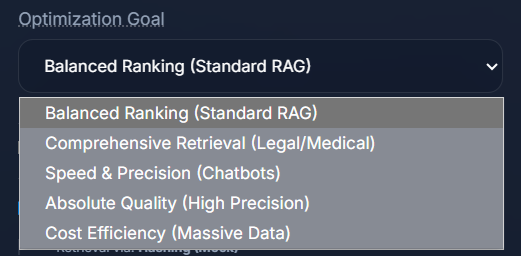
When starting an optimization run in AutoChunks, the most important selection is the Optimization Goal. This defines the intent of your RAG system and mathematically guides the search engine to find the strategy that best meets that intent.
Core Metric Components
Before selecting a goal, it is important to understand the three fundamental metrics that AutoChunks uses. Depending on your selected Goal, one of these will act as your Primary Metric (\(Q\)).
1. Quality (\(Q\)) - nDCG (Ranking Excellence)
What it measures: Whether the correct answer is found at Rank #1. * Formula:
2. Precision (\(M\)) - MRR (Search Efficiency)
What it measures: How quickly a user/LLM finds the first relevant piece of information. * Formula:
3. Coverage (\(C\)) - Recall (Reliability)
What it measures: The percentage of queries where the answer was found anywhere in the top results. * Formula:
The Optimization Goals
We have simplified the optimization process by merging weighting logic and anchor metrics into intent-based goals.
Balanced Ranking (Standard RAG)
The Default. This is the best choice for general-purpose RAG (e.g., enterprise search, documentation bots). It balances quality, precision, and cost.
- Primary Metric (\(Q\)): nDCG@10 (Ranking Excellence)
- Weights: 60% Quality (\(Q\)), 20% Precision (\(M\)), 20% Coverage (\(C\))
- Formula:
Comprehensive Retrieval (Legal / Medical)
Use this when "missing an answer" is worse than "poor ranking." It prioritizes finding the answer anywhere in the context.
- Primary Metric (\(Q\)): Recall@50 (Answer Discovery)
- Weights: 60% Quality (\(Q\)), 20% Precision (\(M\)), 20% Coverage (\(C\))
- Formula:
Speed & Precision (Chatbots)
Optimized for real-time conversational AI where the goal is to get the perfect answer at Rank #1 to minimize LLM reading time and latency.
- Primary Metric (\(Q\)): MRR@10 (First-Hit Precision)
- Weights: 80% Precision (\(M\)), 20% Quality (\(Q\))
- Formula:
Absolute Quality (Highest Precision)
Ignores infrastructure costs and index size to find the strategy that yields the single highest mathematical accuracy.
- Primary Metric (\(Q\)): nDCG@10 (Ranking Excellence)
- Weights: 90% Quality (\(Q\)), 10% Precision (\(M\))
- Formula:
Cost Efficiency (Massive Data)
Focuses on minimizing total chunk count (storage and inference costs) while maintaining a baseline of retrieval quality.
- Primary Metric (\(Q\)): nDCG@10 (Ranking Excellence)
- Weights: 40% Quality (\(Q\)), 60% Efficiency
- Formula:
Analysis Depth (Optimization Mode)
While the Goal defines what to optimize, the Mode defines how hard to search:
- Light (Fast Sample Sweep): Optimized for development. Uses a smaller document sample to find the "ballpark" winning strategy in seconds.
- Full (Exhaustive Corpus Audit): Production-grade tuning. Uses a wider document sample for high-confidence metrics and fine-grained benchmarking.
Next Steps: Once the goal is set and the run completes, you can analyze the specific retrieval stats in the Evaluation Engine.